Interview with beadwork artist Gwen Fisher
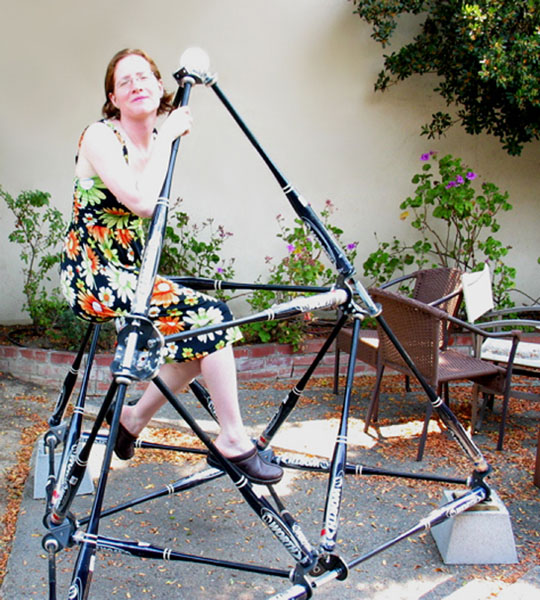
The name of Gwen Fisher (California, USA), a mathematician and a beaded bead designer, is well known as the name of one of the most creative artists. She inspired a lot of beaders with her three-dimensional designs. The questions for this interview were collected by me on a Russian beaders' forum, where I opened a special topic for that, and every visitor could leave his question to Gwen Fisher. I picked up 18 best questions, and Gwen was so kind that she agreed to answer all of them! Thank you, Gwen!
1. When and how did you start beading?
I started weaving beads the first time in my early twenties, but all I did was stringing, fringe, and daisy stitch. Eventually, I got bored and switched to painting, and then quilting. I really took up bead weaving 2003. There was a seed bead shop two blocks from my apartment, and the owner of the shop had a case full of beautiful beaded objects designed by many famous designers. I was captivated, and I wanted to learn how to make some of the pieces, especially the beaded beads. So, I bought a few beads, books and magazines, and I taught myself to weave beads.
2. Who were your teachers in beading? Who inspired you first?
I have never taken a beading or jewelry making class. I learned beading from books and studying photos from websites. My early inspiration came from Carol Wilcox Wells, Sharri Moroshok, Christine Prussing, and Takako Samejima.
3. What was your first beaded item? Do you know where it is now?
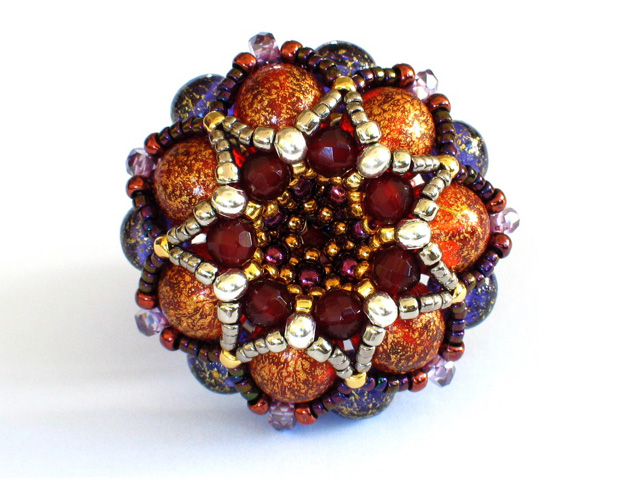
I don't remember what my first beaded item was, but my first beaded bead looks like a lumpy, lopsided raspberry made from brick stitch. It's in my bead box with all of my other ugly beaded beads.
4. What kind of beading technique have you tried? Why did you choose beaded beads?
I've tried almost all of the common off-loom bead stitches done with a needle and thread: peyote, brick, herringbone, and spiral stitches, to name a few. My bead box is full of little samples of these.
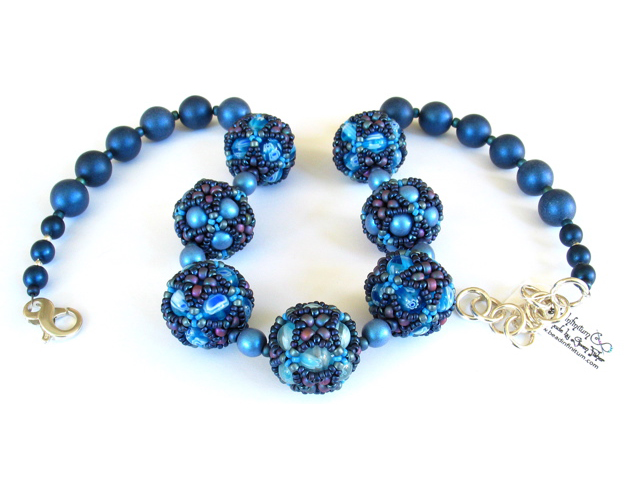
Beaded beads are my favorite projects for several reasons. First, they are little treasures that I can finish in less than a day. Second, discovering new beaded bead designs seemed like a natural and challenging application of the math I love. Since I had been an avid quilt artist for the decade before I started bead weaving, I had plenty of time to fiddle with two-dimensional ideas that I could make with flat fabric. The three-dimensional nature of beaded beads gave me a whole new realm of mathematical ideas to explore. To me, weaving a beaded bead feels like solving a puzzle, and then I have a piece of jewelry when I'm done. Finally, I find something magical about a sparkly bead cluster woven entirely out of beads.
5. What sort of beads do you prefer? How do you pick up beads sizes? Is there the best proportion?
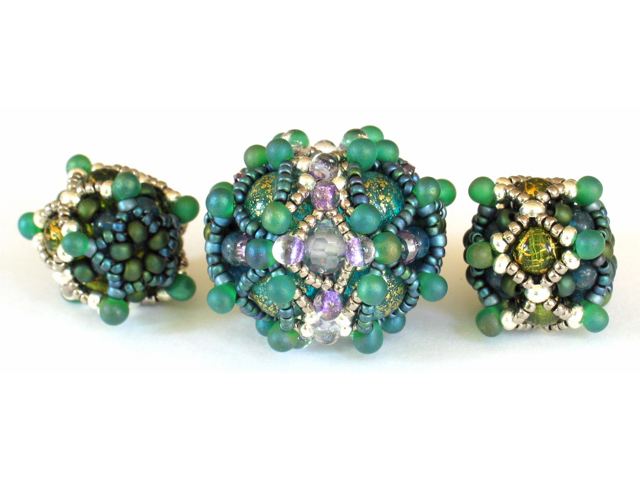
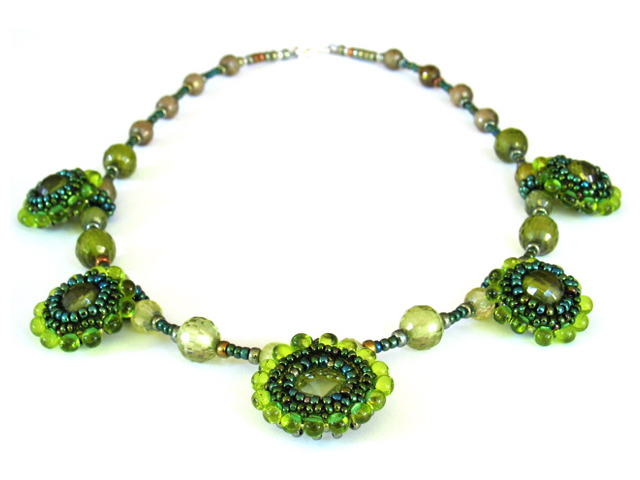
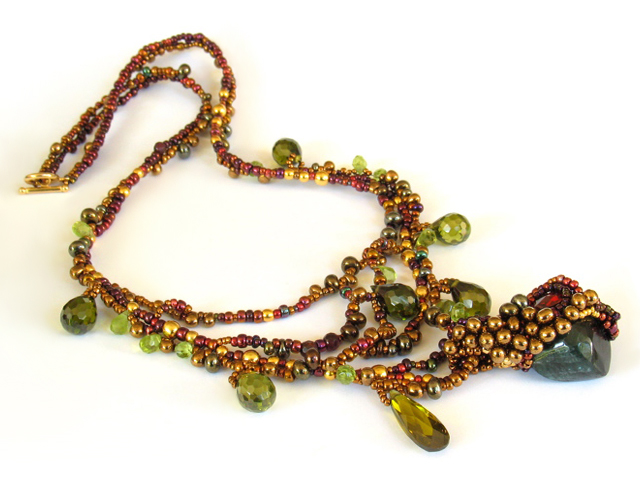
I like to use a wide variety of beads in each of my creations. My favorite beads to use are gemstones, especially sapphire, tourmaline, cubic zirconia, and labradorite, but I don't much enjoy reaming the holes before I use them. Most of the beads I use are glass. As for seed beads, I use sizes 15/0, 11/0, and 8/0 in most of my designs. Smaller beads are too difficult, and larger seed beads are not regular enough for symmetric designs. I almost never use cylinder seed beads because their square profiles do not seem to work as well in my designs as rounded seed beads. For finishes, I like metallic and matte metallic best, along with gold luster. As for glass,I prefer druks and faceted crystals to fire polished beads. Lately, I have been trying to incorporate more drop beads and 2mm and 3mm Swarovski crystals into my work.
6. How much do selected beads define the shape and look of a finished bead?
I especially look for beads that are the same size and shape before I buy them. If I use uneven, irregular beads, a beaded bead will never look very symmetric. Sometimes, I make the same design with different shapes and sizes of beads. This requires changing the counts of the smallest beads to cover the thread neatly. Changing bead sizes can radically change the shape and look of the finished beaded bead. I enjoy experimenting with this.
7. Do you plan your work or don't you know the result in advance?
I usually have some rough sketch of a geometric object before I start beading, but sometimes I just design directly with the beads. When I have a plan, the plan is usually just for the first steps of the basic construction. I generally don't know what the finished object will actually look like. That is one of the things that make it so interesting and keeps me trying new things.
8. How much time does a new bead model take you?
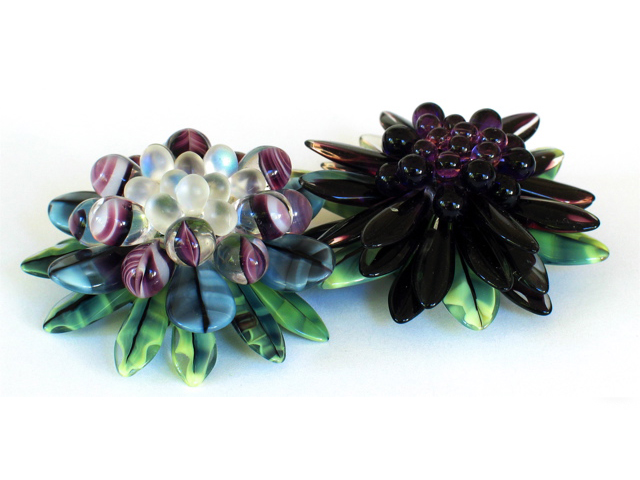
If I am lucky, I can realize a new idea in three hours. If I am unlucky, it takes three months. Once I have an idea, it usually takes me a couple of days to work out a specific design I like. Then, it takes a two or three weeks of full time work to make samples, photograph, write, and illustrate the pattern. I have one design, the Infinity Dodecahedron, that I discovered 2005, but didn't start writing the pattern until September 2007. I just finished it in July 2008. Conversely, I have other designs, such as the Fairy Chrysalis, Flower Ring, and Three Drop Earrings for which I had design and pattern completed in under a month each.
9. Is it possible to improve one's ability to pick up the most appropriate color combination, to define the sizes of beads for a project or is it purely intuitive?
I pick my color combinations deliberately. When I was a quilter, I went to the library at least twice to look at the books on color theory. I flipped through every book they had, and checked out several to read at home. Even with all of this, I have come up with dozens and dozens of ugly color combinations. I found that finding pretty bead color combinations is more complicated than choosing fabric or mixing paint.
As for sizes, I like to use a wide variety, but at the same time end up with a beaded bead that is a good size for jewelry. If I know how many of the largest beads I will need before I start, this helps me decide what size they should be.
10. What do you like in beading trends?
I like people who do their own thing. I like seeing people learn a bunch of different jewelry techniques and then combine or modify them to make new designs that are their own.
11. Beadwork of which modern artists do you like and why?
Gosh, there are so many... Melanie Doerman and Erin Simonetti are both amazing. So are Marcia DeCoster, Cynthia Rutledge, Laura McCabe, Zoya Gutina, and David Chatt. I just learned about Jessica Beels, and I think her work is lovely. I like these artists because their work shows their own style, and they all pay close attention to details. They all have great craftsmanship in addition to developing new ideas with their art. Also, my beading business partner Florence Turnour constantly impresses me with all of the new designs she creates.
12. Are you going to write a book on beaded beads? If yes, when?
I haven't decided. I have thought about it several times, and have written at least three different tables of contents. I keep changing my mind about what I would put in a single bound book. I think if I do ever compile a book, it will have different chapters for different bead weaving techniques. It probably won't all be on beaded beads.
13. Do you participate in any beading contests and exhibits? If yes, where?
I entered one beading contest, and I didn't make the finals. Then, I decided that winning a contest is not that important to me. I have noticed that the pieces that seem to win are large with lots and lots of beads, which is not my style. I don't enjoy making art to appeal to judges of competitions. Also, some contests seem to be much more about promoting the sponsors of the contest than the artists who contribute. So I haven't entered any more contests. I would rather put my time and energy in to writing patterns.
I do exhibit my work occasionally. Trios Gallery, near San Diego, California sells my jewelry, and I do home parties every few months. I have exhibited my work several times at mathematics and math/art conferences such as those sponsored by the American Mathematics Society and Bridges.
14. How can you combine your main job and beadwork?
I am currently on leave from my position as Associate Professor of Mathematics at California Polytechnic State University, San Luis Obispo. This gives me lots of time for beading. Before I was on leave, I used most of my free time for my art. Also, I found that if I focused my hobby on mathematical art, I could write papers and present them at meetings. That way, my hobby became part of my job. In fact, this was my original motivation for writing about my artwork.
15. Did you like mathematics since you were at school or did it come later?
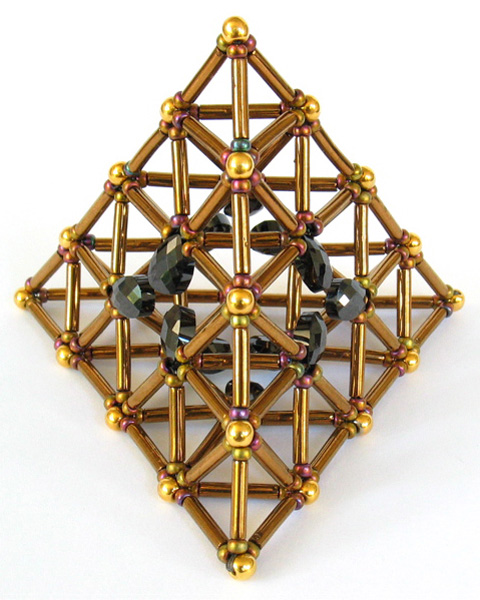
I have always liked mathematics and spatial reasoning, and I have always been very good at both. My favorite books to read as a child were puzzle books. I entered college as a math major with an emphasis on teaching, and I never changed my focus.
16. What kind of hobby except mathematics and beading do you have?
I was obsessed with quilting for 10 years before I started weaving beads. I also dabbled in other needlecrafts including sewing, embroidery, cross stitch, silk ribbon embroidery, weaving, and crochet. In high school and college, I painted and drew very regularly, but I do all of these hobbies much less now than I bead. Other hobbies I have had in the past include cooking, growing orchids, calligraphy, and origami.
17. Do you like the tales of your colleague mathematician Lewis Carroll?
I have always been a big fan of Lewis Carroll. My favorite character of his invention is the Cheshire Cat. I have read Alice in Wonderland and Through the Looking Glass many times, and I even tried reading his book on Symbolic Logic once, but I didn't get too far.
18. Do your family and your coworkers support your beading passion?
My family is very supportive of my work. My mother and sister wear my jewelry every time I see them. I have also received much support for my art from the larger mathematics community. I gave formal talks on the symmetry of beaded beads at two math conferences, and they were very well attended.
Thank you, Gwen! We love your mathematical beadart and wish you best of luck!
Beaded beads by Gwen Fisher
Bat Country project by Gwen Fisher
About artist:
Gwen Fisher, Ph.D, California, USA
E-mail address: gwen(at)beadinfinitum(dot)com
Website: www.beadinfinitum.com


 jewellery
 accessories
 jewelry
 fashion
 shopping
 bracelets
 beads
beads handmade beaded jewelry
 beading
 helmi
helmi gioielli
 smykker
 takı
takı juvelen
 lampwork beads
 The Jewelry Blog
 jewelry trends
 ruby necklace
 ruby bracelet
 rubies


 handmade necklace
 coral bracelet
 coral
coral